

flydocs and Tigerair Taiwan partner to accelerate aircraft records digitisation across the airline’s fleet
flydocs and Tigerair Taiwan sign a five-year agreement at MRO Asia-Pacific 2026 to digitise and streamline records management using the advanced Digital Records Management (DRM) Next Generation.
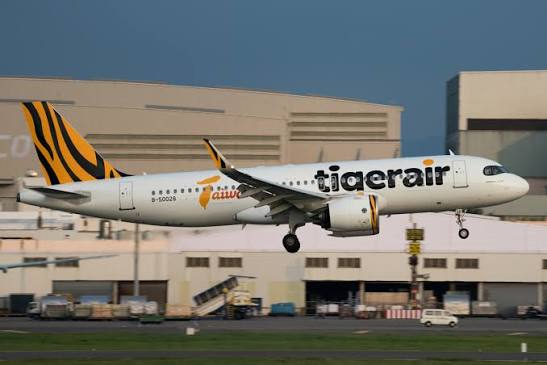
Tigerair Taiwan will implement flydocs’ advanced DRM Next Generation platform, gaining greater control over aircraft records, reducing manual processes, enhancing compliance readiness, and improving data accuracy and visibility.
flydocs, the global aviation leader in digital records, asset management, and engineering services, today announced the signing of a five-year agreement with low-cost carrier Tigerair Taiwan, a China Airlines Group company, during MRO Asia-Pacific 2026 in Singapore. flydocs will digitise and streamline records management using its advanced Digital Records Management (DRM) Next Generation across the airline’s extensive regional network and fleet of 17 aircraft.
The partnership was formally signed by Pierluigi Calù, Vice President-Digital Tech Ops Ecosystem, Asia-Pacific, Swiss AviationSoftware (Swiss-AS) and Kevin Kuo, Senior Manager of Engineering & Maintenance, Tigerair Taiwan, during MRO Asia-Pacific, one of the region’s leading events for the commercial aviation aftermarket and MRO industry.
“Today’s partnership marks an important step in strengthening collaboration across the Digital Tech Ops Ecosystem in the Asia-Pacific region. By bringing together our digital capabilities and industry expertise, we are creating new opportunities to improve operational efficiency, enhance connectivity and deliver greater value for our customers. By adopting flydocs’ DRM Next Generation, Tigerair Taiwan will reduce manual effort, enhance compliance readiness, and have more accurate, reliable asset data. These capabilities will help streamline operations, support informed decision-making and enable long-term value creation across its fleet. We are delighted to formalise this collaboration with Tigerair Taiwan at MRO APAC in Singapore and look forward to translating our shared vision into meaningful outcomes for the aviation industry.”
— Pierluigi Calù, Vice President-Digital Tech Ops Ecosystem, Asia-Pacific, Swiss AviationSoftware (Swiss-AS)
As part of the partnership, DRM Next Generation features a completely refreshed interface designed to streamline user journeys and speed up daily tasks. flydocs will deliver a comprehensive digital solution for managing aircraft records and asset data, ensuring smooth integration. With flydocs’ streamlined Onboarding and process adoption, this long-term partnership with Tigerair Taiwan will also optimise their processes.
“We are pleased to partner with Tigerair Taiwan as it advances its vision of becoming a fully digitised airline. Through our flagship DRM Next Generation solution, the airline will gain enhanced visibility, stronger data integrity and greater control over its aircraft records across the entire fleet lifecycle. As a fast-growing carrier operating in a highly competitive regional market, Tigerair Taiwan’s selection of flydocs as its Partner of Choice is a testament to the value and innovation our solutions deliver. We look forward to supporting the airline’s digitisation transformation journey and working together to drive measurable efficiencies, long-term value, and sustainable success.”
— Jennifer Ioannidou, Chief Product Officer, flydocs
“Partnering with flydocs, a trusted and global leader in digital records and asset management with extensive experience, marks an important step in enhancing the efficiency and accuracy of our technical records management. We are looking forward to adopting their DRM Next Generation and innovative approach to streamline our processes, maximise efficiency, and ensure real-time compliance, thereby positioning Tigerair Taiwan for future expansion of digital services.”
— Kevin Kuo, Senior Manager of Engineering & Maintenance, Tigerair Taiwan
MRO Asia-Pacific 2026
Join us at MRO Asia-Pacific 2026 from 23–24 September 2026 at Booth #1902, Singapore Expo Convention and Exhibition Centre.
About the Digital Tech Ops Ecosystem
Lufthansa Technik’s Digital Tech Ops Ecosystem is a flexible, multi-application suite consisting of AVIATAR, the independent platform for data and analytics; AMOS, the world-leading software for maintenance and engineering; and flydocs, global leaders in digital records and asset management; enhanced by Digital Tech Ops Engineering. Each solution operates independently but is designed to work seamlessly together, offering modular, integrated services through a customer-centric, collaborative approach along the whole value chain of technical operations. The Ecosystem is designed to boost process efficiency, reduce technical operating costs, enhance operational stability, and maximise aircraft availability and asset value across the full lifecycle, including lease transitions.
About Tigerair Taiwan
Tigerair Taiwan launched its first route in 2014. As Taiwan’s first and only low-cost carrier (LCC), it operates routes across Asia, providing travelers with affordable, reliable, and convenient options. Focusing on a warm, passionate, and genuine service while upholding safety as its core value, Tigerair Taiwan continues to expand its footprint and add more destinations in Asia. Learn more at www.tigerairtw.com.
About flydocs
flydocs is an asset management solution provider with the aviation industry’s most comprehensive solution for creating value out of aircraft maintenance data. We offer the tools and expertise that allow all industry stakeholders to drive sustainable innovation to help build the future of the commercial aviation asset lifecycle.
Recognised as a global leader in digital records management, flydocs was founded in 2007 and is 100% owned by Lufthansa Technik. With over 300 employees across multiple locations worldwide, flydocs is trusted by over 75 airlines, lessors, and MROs to deliver measurable, long-term operational and cost efficiencies.
Veryon Acquires Polaris Aero, Adding Safety Management to its Aviation Maintenance Software Suite
The move strengthens Veryon’s role as the aviation industry’s most comprehensive provider of maintenance software solutions.
SAN FRANCISCO, Calif. (September 3, 2026) —Veryon, a leading provider of software solutions for the aviation industry, has acquired Polaris Aero, an aviation software company headquartered in Scottsdale, Arizona. Since 2007, Polaris Aero has delivered innovative safety management solutions to aircraft operators and MROs worldwide.
“We are thrilled to bring Polaris Aero’s proven safety solutions into the Veryon software suite,” said Bethany Little, Chief Executive Officer of Veryon. “It’s a pivotal step towards a better alignment between aviation safety and maintenance, enabling smarter and safer decisions across every phase of customers’ operations.”
The acquisition adds over 200 new customers to Veryon’s portfolio, further reinforcing its position as the aviation industry’s most comprehensive provider of maintenance software solutions. Polaris Aero’s products include VOCUS SMS, FlightRisk, and GroundRisk, which are widely used by corporate flight departments, charter operators, and MROs to streamline compliance, assess risk, and enhance operational safety.
The move also combines Polaris Aero’s de-identified data from 112,000+ safety reports, 32 million+ FlightRisk assessments, and 174 million+ flight hazards with Veryon’s dataset of 100 million+ maintenance events, creating the industry’s most extensive source of aviation safety and maintenance data. This expanded dataset will sharpen the accuracy and reach of Veryon AIRE, its AI-powered data intelligence platform, giving operators more precise insights into both safety risks and maintenance needs.
“Joining forces with Veryon is an exciting next chapter for Polaris Aero,” said Chris Connor, Chief Executive Officer of Polaris Aero. “Our mission has always been to help operators manage risk and streamline compliance through smarter safety programs. With Veryon, we can scale that mission even further, integrating safety and maintenance in ways that deliver more value, more efficiency, and ultimately, safer operations for our customers.”
In the short term, Polaris Aero will continue operating as its own business unit, with all current products, contracts, and support continuing unchanged. Over the coming months, both companies will carefully map out and implement their long-term integration plan. The end goal is to enable aircraft operators and maintainers to manage operations more safely and efficiently. Benefits will include:
- One partner, complete coverage: Customers will be able to access maintenance tracking, MRO management, safety management, and more from a single provider.
- Two teams, one point of contact: Polaris Aero’s safety specialists and Veryon’s maintenance specialists will support the same customer together, ensuring operators get more informed and aligned guidance.
- More data, better decisions: Polaris Aero’s and Veryon’s AI-powered tools will work hand in hand to connect safety insights with maintenance and reliability data.
- Streamlined compliance: AD/SB tracking, SMS reporting, and audit prep will be able to run across multiple solutions.
- Insights flow both ways: Safety data will more easily inform maintenance decisions, with maintenance data informing safety practices.
“Safety and maintenance have always been two sides of the same coin, but they’ve rarely been managed that way,” said Pete Bunce, former CEO of GAMA and Senior Advisor to Veryon. “Bringing Polaris Aero’s safety intelligence together with Veryon’s maintenance data gives operators a single, connected view of risk and reliability. That’s exactly the kind of data-driven decision-making our industry needs right now.”
For more information about Veryon and Polaris Aero, please visit their respective websites at veryon.com and polarisaero.com.
About Veryon
Veryon is the leading provider of aviation software and information services, trusted by over 5,500 customers, 75,000 maintenance professionals, and more than 100 OEMs in nearly 150 countries. Powered by the world’s largest de-identified aviation maintenance dataset, which contains over 100 million events, the all-in-one Veryon suite combines OEM-authorized publications, intuitive cloud-based maintenance workflows, and AI-driven insights to help operators, MROs, and OEMs maximize flying time without compromising safety or compliance. Committed to helping customers achieve long-term success, Veryon brings together innovative aviation software, expert guidance, structured training, and ongoing support to help organizations realize faster adoption and stronger operational outcomes. Drawing on Veryon’s 50+ years of experience and support from experts who understand aviation, Veryon customers have achieved up to a 75 percent reduction in troubleshooting time for new technicians and up to a 23 percent reduction in downtime costs. Learn more at veryon.com.
About Polaris Aero
Polaris Aero, headquartered in Scottsdale, Arizona, has been helping operators manage risk and maintain compliance for over a decade with data-driven safety management solutions. Its suite of products, including VOCUS SMS, FlightRisk, and GroundRisk, empowers operators to identify hazards, mitigate risk, and streamline compliance across flight, maintenance, and ground operations.
Transavia France Strengthens Operational Excellence with Comply365
The airline extends its use of ContentManager365 for a superior and connected, end-to-end operational content ecosystem
Beloit, Wis. / Bristol, England / Paris, France – 4 August, 2026 – Comply365, LLC (“Comply365”), a leading global provider of operational content, safety and training management solutions for the aviation, rail, defense and space industries, has further strengthened its partnership with Transavia France through the successful expansion of ContentManager365 to include operational content authoring for Company Manuals, driving greater efficiency, compliance and content governance for superior operational performance.
A long-term Comply365 customer for publishing and distribution across Flight Operations and Engineering, Transavia France moved to ContentManager365 Authoring as part of its strategy to streamline the operational content lifecycle and establish a single, integrated environment for creating, managing, and distributing critical operational content.
The expanded deployment of ContentManager365 addresses key challenges associated with revision management, content connectivity, consistency, and fragmented workflows. By bringing authoring, publishing, and distribution together within one platform with ContentManager365, Transavia France benefits from a highly efficient and controlled process for managing operational content across the organization.
“At Transavia France, we are committed to investing in modern technologies that drive operational excellence and support the evolving needs of our business,” said Sylvain Fagot, EVP Fleet, Engineering & Maintenance Transavia France. “As our operations continue to grow, having a connected and scalable approach to operational content management is essential. Expanding our use of ContentManager365 enables us to manage the entire operational content lifecycle within a single environment, improving efficiency, strengthening compliance, and enhancing collaboration across teams, while ensuring our people always have access to the accurate, current information they need to perform their roles safely and effectively.”
“We are delighted to deepen our partnership with Transavia France as it continues to advance its operational performance with ContentManager365,” said Ilia Kostov, CEO of Comply365. “Building on the success already achieved with our solutions, the airline’s expanded use of ContentManager365 will accelerate operational efficiency, strengthen compliance, and ensure greater consistency across its critical operational content. This unified approach not only reduces complexity and risk but also provides a solid digital foundation to support Transavia France’s continued growth and innovation.”
About Comply365
Comply365 is a leading provider of Operational Content Management, Safety Management and Training Management in the highly regulated industries of aviation, defense, rail and space. Comply365 provides an AI-powered combination of expertise and products underpinned by unified best practices, empowering its customers to elevate operational excellence, transform safety management and training management, with closer integration of relevant data sets across domains. The Comply365 product portfolio ensures its customers’ crews and assets are always geared for peak operational performance, unlocking financial and operational gains through more streamlined, robust and agile operations. Comply365 is the trusted technology partner of many of the most progressive aviation, defense, rail and space organizations worldwide. For more information, please visit comply365.com.
About Transavia
Transavia, the low-cost airline of the Air France-KLM group, operates nearly 400 routes from France (Orly, Nantes, Lyon, Montpellier and Marseille), the Netherlands (Amsterdam, Rotterdam, Eindhoven) and Belgium (Brussels) to France, Europe and the Mediterranean basin. In 2025, Transavia France sold 16 million seats. Today, it is the leading low-cost airline departing from Paris (Beauvais, Charles de Gaulle, Orly). With more than 3,500 employees in France, Transavia is committed to service quality, crew proximity and innovation. A commitment that regularly earns it awards. For the sixth year running, Transavia France was voted Customer Service of the Year 2026 in the Public Passenger Transport category. For the sixth time, it was also awarded the “Meilleure Enseigne” label by Capital magazine and received the Qualiweb 2025 trophy for its online services in the Tourism and Transport category. Finally, Transavia France received the Travel Trust Award from Skyscanner, for the best booking experience. Transport category. Finally, Transavia France received the Travel Trust Award from Skyscanner, for the best booking experience.
Porter Airlines goes live with Lifecycle Asset Management solution from flydocs
flydocs, the aviation global leader in digital records, asset management, and engineering services, today announced the successful migration and Go-Live of its Lifecycle Asset Management (LAM) solution for Porter Airlines. This collaboration builds on Porter Airlines’ existing Digital Records Management (DRM) platform powered by flydocs, thereby enhancing its operational efficiency and fleet management capabilities.
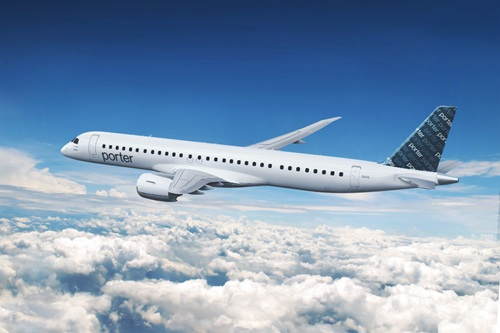
Being the first LAM customer in the Americas, Porter Airlines will now benefit from integrating its flydocs DRM platform with flydocs LAM to meet lease return conditions, supported by predictive analytics and scenario modelling that enable smarter decisions on maintenance, costs, and the risk of penalties during aircraft transitions. This significant collaboration also reinforces Porter Airlines’ existing partnership with Lufthansa Technik’s Digital Tech Ops Ecosystem-Swiss AviationSoftware, the developer of the leading maintenance and engineering (M&E) software AMOS, as they announce the successful launch of their Tech Ops Live for real-time fleet visibility. Through this, operational stakeholders will be able to access a broader technical picture in a single mobile app, consolidating real-time fleet status, maintenance progress, operational KPIs, and lease return information into a single view.
Speaking on the occasion, Arne Schlossmacher, Head of Sales & Customer Development, Digital Tech Ops ecosystem Americas, said, “We are proud to strengthen our valuable partnership with Porter Airlines as we Go-Live with our innovative LAM solution, enabling them to monitor the live technical status of their assets against lease conditions. With LAM, they can now plan maintenance events and deliveries more effectively and manage operational costs. This partnership creates a strong foundation for the region, and we are looking forward to further expanding it by supporting Porter in its digital transformation and adoption of our digital TechOps ecosystem.”
Gavin Pais, Director, Maintenance, Porter Airlines, expressed, “As we scale our operations at Porter, we are creating a more connected approach to aircraft records, asset management and maintenance data. By adopting the Lifecycle Asset Management solution from flydocs, we are reducing system complexity and increasing planning, especially for maintenance reserve tracking and lease return management. The solution will transform our approach to asset management across the aircraft lifecycle.”
About flydocs
flydocs is an asset management solution provider with the aviation industry’s most comprehensive solution for creating value out of aircraft maintenance data. We offer the tools and expertise that allow all industry stakeholders to drive sustainable innovation to help build the future of the commercial aviation asset lifecycle.
Recognised as a global leader in digital records management, flydocs was founded in 2007 and is 100% owned by Lufthansa Technik. With over 300 employees across multiple locations worldwide, flydocs is trusted by over 75 airlines, lessors, and MROs to deliver measurable, long-term operational and cost efficiencies.
For more information, please contact:
flydocs
Kshitija Sharma
Regional Lead – Asia-Pacific, Marketing & Communications, Digital Tech Ops Ecosystem
Email: kshitija.sharma@flydocs.aero
Finnair takes the next step towards ONE Order with Lufthansa Systems
- Lufthansa Systems expands its cooperation with Finnair to implement its order-based accounting solution – SIRAX/ONE Order
- SIRAX/ONE Order will help Finnair streamline its financial management processes through fully automated and real-time order accounting and settlement
- Lufthansa Systems supports Finnair’s ONE Order journey in building up a 100% Offer and Order World with comprehensive transition expertise.
Raunheim, 1st July 2026. Finnair has selected SIRAX/ONE Order, the order accounting and settlement solution from Lufthansa Systems, as a major step in its transition towards IATA ONE Order and modern airline retailing. As one of the pioneers in the industry, the airline benefits from the combined Revenue and Order Accounting expertise at Lufthansa Systems when marking a significant milestone in its long-term financial management modernization strategy. The solution enables Finnair to move towards fully automated, real-time order accounting and settlement in the longer term.
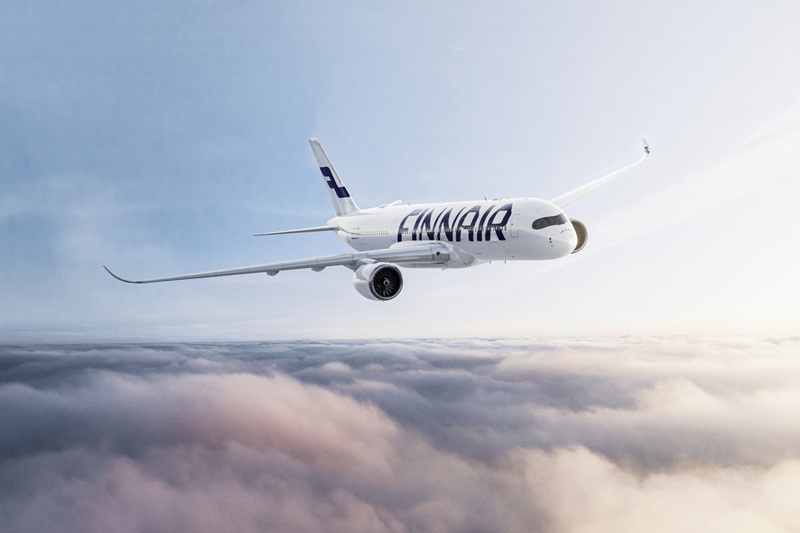
Supporting Finnair’s journey with trusted financial management expertise
The transition towards modern airline retailing is a major transformation in the aviation industry. Airlines are moving away from traditional PNR-, e-ticket-, and EMD-based processes towards a world centered around offers, orders, and services.
Finnair is already a long-standing customer of several solutions from the Lufthansa Systems portfolio, including SIRAX/Revenue Accounting. The introduction of SIRAX/ONE Order marks the next step in this partnership.
“One important enabler for delivering an enhanced airline customer shopping and travel experience and unlocking additional revenue potential lies in the modernization of our distribution and financial management areas with modern airline retailing. With SIRAX/ONE Order as a financial management solution, we are taking an important step in embracing IATA’s ONE Order framework and gradually reducing reliance on legacy PNR-, e-ticket-, and EMD-based processes over time. At the same time, we are advancing towards a unified order-driven architecture that supports modern airline retailing. Our existing partnership for Revenue Accounting gave us confidence in the solution’s capabilities and the financial management expertise at Lufthansa Systems. As we continue this journey, it is important for us to work with a partner that can support our evolving requirements while helping us navigate this transformation step by step,” said Laura Lindborg, Director Order & Payment Management at Finnair.
As part of this transformation, Finnair will implement SIRAX/ONE Order together with the SIRAX/Bilateral Settlement Manager. The solution complements SIRAX/ONE Order by enabling automated direct settlement with retailing partners. This allows Finnair to maintain flexibility across different settlement environments. Moreover, it enables the rapid addition of any retail partner to create attractive and competitive customer-oriented airline retailing offers.
Proving interoperability in the ONE Order world
Finnair’s decision demonstrates this IATA modularity approach in practice: SIRAX/ONE Order was designed as an open, modular, and cloud-based solution that enables airlines to combine their preferred Offer and Order Management system with dedicated order accounting and settlement capabilities. The solution allows them to select the components that best fit their needs. Lufthansa Systems has already validated the interoperability between Order Management and Order Accounting modules in the past, reinforcing the industry’s move towards open, standards-based architectures.
“Modern airline retailing requires openness and interoperability. Airlines want the freedom to select the solutions that best support their business strategy without compromising on integration. SIRAX/ONE Order was designed exactly for this purpose. Finnair’s approach shows this can be realized in practice, creating a seamless and future-ready end-to-end airline retailing ecosystem,” said Tim Bruegmann, Chief Product Owner Financial and Commercial Products at Lufthansa Systems.
About SIRAX/ONE Order
SIRAX/ONE Order is the most advanced financial management solution, fully capable of ONE Order integrations. It streamlines finance processes in line with IATA ONE Order and Settlement with Orders (SwO), enabling airlines to fully automate order accounting and settlement while reducing complexity. Its modular, cloud-native architecture allows airlines to combine it with any Offer and Order Management solution that best meets their needs. The stand-alone application works seamlessly with any legacy Revenue Accounting system on the market regarding the parallel processing of legacy documents and orders when building up the Offer and Order World.
About Finnair
Finnair is a network airline, specialising in connecting passenger and cargo traffic between Asia, North America and Europe. Finnair is the only airline with year-round direct flights to Lapland. Customers have chosen Finnair as the Best Airline in Northern Europe in the Skytrax Awards for 15 times in a row. Finnair is a member of the oneworld alliance. Finnair Plc’s shares are quoted on Nasdaq Helsinki.
company.finnair.com
About Lufthansa Systems
Lufthansa Systems GmbH, the leading airline IT provider, has been shaping the future of digital aviation for more than 30 years. Helping airlines unlock their full potential, it combines profound industry know-how with advanced technological expertise. A subsidiary of the Lufthansa Group, the company offers its more than 350 customers worldwide a portfolio with often market-leading products that cover all airline business processes – on the flight deck, in the cabin, and on the ground. Lufthansa Systems is committed to improving its own environmental footprint and that of its airline customers of all sizes and business models. As part of an international airline ecosystem, it connects diverse expertise across APAC, EMEA and the Americas.
www.LHsystems.com
Press Contact
Lufthansa Systems GmbH
Press Office
Mr. Ansgar Luebbehusen
Mrs. Ida Seibert
Tel.: +49 (0)69 696 90000
E-Mail: publicrelations@LHsystems.com
Yonder Launches On-Device AI for Content Management
Swiss documentation platform introduces AI capabilities that run entirely on Apple devices – no cloud, no data transmission, available offline.
Zurich, Switzerland – June 2026 – Yonder, the Swiss smart content management platform, today announced the availability of on-device AI across its platform. The feature generates document summaries directly on Apple devices using Apple’s on-device intelligence, with no internet connection required, no data leaving the device, and no additional cost to existing subscribers.
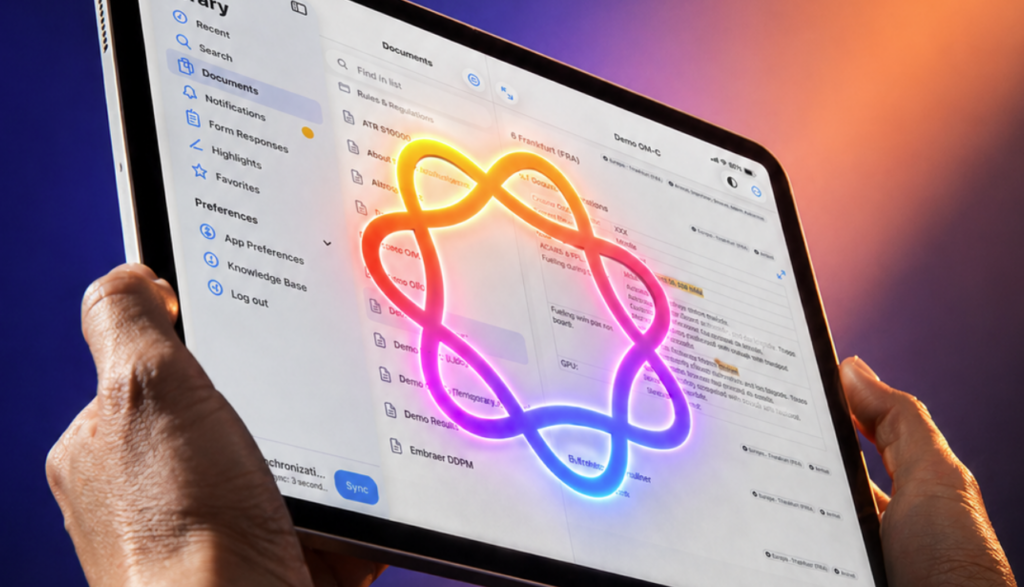
The release marks a deliberate departure from the prevailing approach to AI in enterprise software, where data is typically transmitted to cloud servers for processing. Yonder’s implementation requires no external server, no third-party AI provider, and no network connection – making it the first AI documentation feature of its kind approved for use in NATO-restricted environments.
“Most AI features ask you to trust that your data is handled responsibly somewhere else — we made a different choice. The AI runs on the device in your hands. Your documentation never leaves it.”
Thomas Vogel
Founder & CEO/CPO, Yonder
The capability is built on Apple’s on-device intelligence framework, available on iPhone 15 Pro and newer and compatible iPad models running iOS 18 or later. In February 2026, Apple became the first and only consumer device manufacturer to receive approval for handling classified information in NATO-restricted environments – a certification that extends directly to Yonder’s AI feature.
For aviation operators, airports, and other safety-critical industries where data sovereignty and offline access are operational requirements rather than preferences, the distinction is significant. Cloud-based AI tools are frequently prohibited by internal policy or regulatory frameworks in these environments. Yonder’s on-device approach removes that barrier entirely.
The feature is available immediately to all Yonder subscribers at no additional cost. AI summaries can also be disabled at the organizational level for operators who prefer not to use the AI feature.
About Yonder
Yonder is a smart content management platform that transforms static manuals and regulations into dynamic, role-based content for aviation, airports, and defense organizations. By combining powerful automation for document managers with an intuitive, offline capable reading experience for end users, Yonder enables organizations to manage critical information more efficiently, safely, and in full compliance with regulatory requirements.
Evoke launches mobile-friendly training management on App Store and Google Play
Evoke Systems Limited, a global innovator in aviation software solutions, has announced the continued evolution and now expanding reach of EFOS Mobile. The next-generation mobile extension of EFOS Training is designed to bring operational capability directly into the hands of every user, wherever they are, providing real-time visibility of their progression, competencies, and training requirements directly from their mobile device.
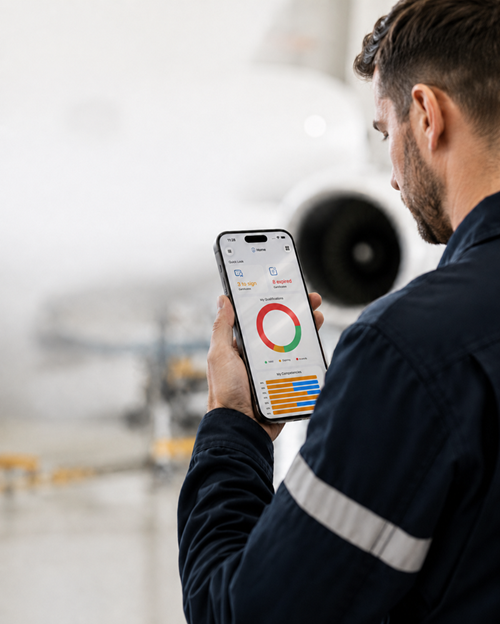
Now available on both the App Store and Google Play, it enables seamless access to training data, records, and workflows without the need for fixed workstations. This removes traditional barriers to access for all teams, including pilot, cabin crew, maintenance, operations, and engineering.
EFOS Mobile is not a new concept. It is a proven and widely adopted capability that continues to evolve alongside the needs of training and compliance teams across the industry. With each release, the platform is refined and expanded based on direct user feedback and operational requirements.

Kerry Mitchell, Cabin Crew Training & Compliance Manager at AirTanker – one of the early adopters of the EFOS Mobile – said:
“The app allows users to upload key documents, view forms, and understand their own performance through features such as competency heatmaps and detailed graphs. It gives individuals a much clearer picture of where they are performing well and where there may be opportunities for further development.”
Supporting dynamic workflows
Built with inclusivity and accessibility at its core, EFOS Mobile ensures that training is no longer confined to fixed systems or office-based environments. For organisations with distributed teams, shift-based staff, and frontline personnel, it provides a practical way to engage with training requirements using only a personal smartphone. By removing the dependency on static training environments for training administration and updates, EFOS Mobile ensures that training visibility and compliance management are not only consistent across the entire workforce, but also more efficient.
Beyond training access, EFOS Mobile improves day-to-day operational workflows by giving employees quicker access to core information wherever they are working. This supports faster acknowledgement and sign-off rates, while fostering greater transparency and understanding across teams.
With operational documents securely stored in a virtual wallet, employees can access essential information directly from their mobile device at the point of need. Whether reviewing procedures, confirming training records, or accessing operational guidance, EFOS Mobile ensures critical resources remain readily available in dynamic working environments.
Supporting career development
In addition to improving accessibility, EFOS Mobile is also influencing how organisations think about training pathways and career development. By making training more visible, intuitive, and readily available, it supports clearer progression routes through comprehensive personal dashboards and structured development journeys aligned with modern aviation training methodologies, including Competency-Based Training and Assessment (CBTA), Evidence-Based Training (EBT), Assessment and Qualification Training Programmes (ATQP), and broader Competency Management System (CMS) frameworks.
Platform Highlights
Capabilities include secure access to training records, course tracking, notifications, and key updates within EFOS Training, all delivered through a mobile-first interface designed for clarity, speed, and ease of use.
With continuous updates delivered through the App Store and Google Play, EFOS Mobile is constantly evolving in response to user needs and industry change.
Looking ahead
Looking ahead, Evoke continues to invest in expanding the EFOS Training ecosystem, with EFOS Mobile playing a critical role in delivering more accessible, intelligent, and connected training management across aviation organisations worldwide, including airlines, ATOs, Training Academies and more.
EFOS Mobile is available now on the App Store and Google Play.
Not using EFOS Training yet? Book a demo today.
Why Legal Workflows Need to Evolve: Navigating Change in Legal Documentation at Scale

Legal teams aren’t short on expertise; they’re short on scalable content change management solutions.
Every regulatory update, law revision, or policy amendment sets off a complex chain of document updates, reviews, and approvals, yet many legal workflows rely on manual reviews and outdated technology, simply not fit to handle continuous change across the mix of unstructured formats like DOCX and PDF and structured formats such as XML. Research shows that legal teams spend as much as 11.2 hours per week dealing with document creation and management challenges, with about 6 hours a week wasted on documentation issues, a hidden cost that compounds when legal teams are navigating multiple document versions, formats, and systems. The result is growing operational risk, inconsistencies, and governance models under pressure.
For legal operations and technology leaders, evolving legal workflows is essential to maintaining control, confidence, and compliance.
When Poor Change Management Becomes a Risk Multiplier
Unmanaged content change is one of the most common, and least visible, sources of risk in legal environments. Many legal teams still depend on manual revisions and a patchwork of legacy tools: word processors, spreadsheets, email chains, and static document repositories. While familiar, these tools were never designed for continuous, large-scale content change management. In fact, 90% of “proofread” legal documents still contain errors, emphasizing how traditional content change management practices break down at scale.
When updates are tracked inconsistently and reviewed using legacy tools, organisations expose themselves to errors that can cascade across multiple documents, systems, and teams. Industry analysis of law firm workflows suggests document management challenges cost firms approximately 9.8% of their total productivity, translating into less time spent on billable work and more time on administrative overhead. This underscores a critical reality: accuracy at scale cannot rely solely on human effort. As content volumes increase, manual quality control becomes both unsustainable and unreliable.
What’s needed is a structured, scalable approach, one that treats content change management as a defined lifecycle rather than an afterthought. That shift starts by rethinking how change is detected, processed, and understood across legal documentation at scale.
Rethinking the Content Change Management Lifecycle
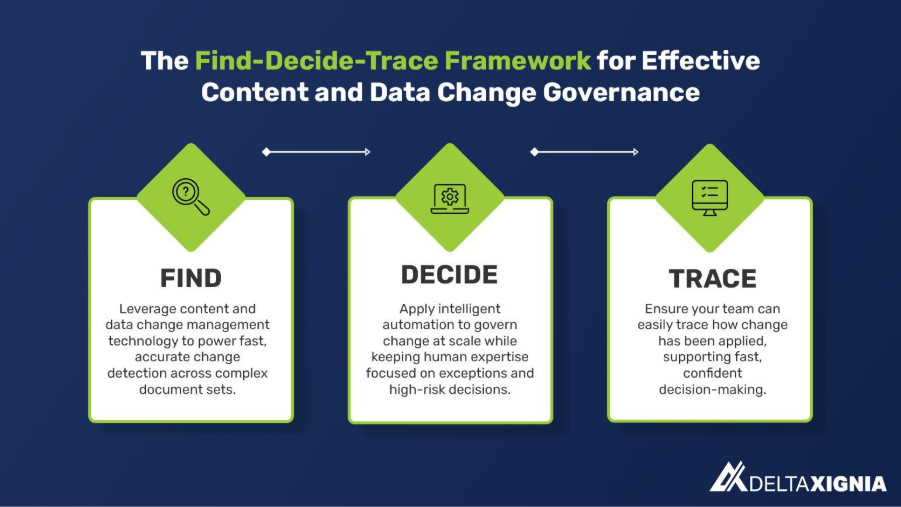
To manage legal documentation effectively at scale, you need to first rethink content and data change management as a structured lifecycle rather than a series of ad hoc tasks. Whether teams are working in highly complex enterprise environments or more autonomous, self-managed SME organisations, effective content change governance follows the same core lifecycle, which can be applied through the Find-Decide-Trace Framework.
1. Find Changes
The first challenge is knowing what has changed from one version to another. A regulatory update or court decision can impact hundreds, sometimes thousands of templates, precedents, guidance notes, and client-specific variants stored across different systems. For legal teams who need to manually review these large document sets, the whole process is tedious and increases the risk of human error.
This is where a scalable, high-accuracy content and data change management solution is critical, allowing legal teams to find change across large document sets at speed while maintaining confidence that all relevant differences have been identified.
2. Decide How Change Should Be Handled
Once change is detected, legal teams must decide how each change should be handled. At scale, making these decisions manually across hundreds of documents becomes slow and inconsistent. Using the right content change management technology allows legal teams to process change intelligently, supporting rule-based automation while keeping human judgment in the loop for exceptions and high-risk decisions.
3. Trace and Visualise Change
After decisions are made, it is essential to trace how change has been applied. Legal teams need clear, human-readable view into what changed, where it changed, and how it was handled. Manually going through hundreds of pages just to find which section changed is an unnecessary bottleneck that slows down reviews and diverts expert time away from higher-value work. Effective traceability makes change transparent and auditable, enabling faster review, stronger governance, and greater confidence that updates have been handled correctly.
Real-World Impact: Navigating Change with Confidence
The value of structured, scalable content change management technology, built around clear principles for finding change, making informed decisions, and maintaining traceability, is already delivering measurable results for legal information providers worldwide. Whether you are managing large volumes of legal documentation internally or migrating vast content libraries from one system to another, robust content change management is critical. Choosing the right technology can drastically accelerate these processes while ensuring the level of precision and reliability that legal environments demand.
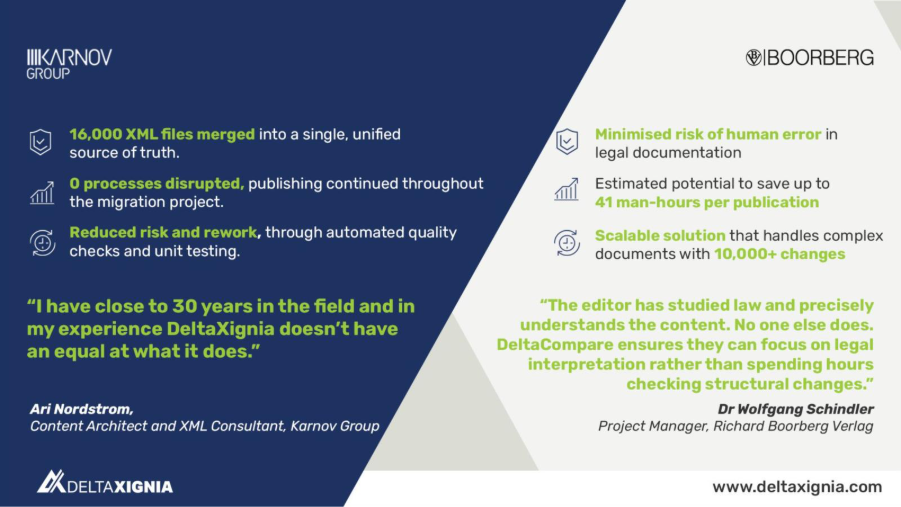
For example, Karnov Group, a leading Nordic legal information provider, used DeltaXignia as part of a large-scale content migration project, successfully merging more than 16,000 XML files into a single, unified source of truth through a fully automated pipeline. By leveraging DeltaXignia’s high-precision content change management capabilities, Karnov was able to validate large volumes of content efficiently and establish a reliable foundation for ongoing updates at scale.
Another great example of impact is Richard Boorberg Verlag, a long-established German legal publisher, which uses DeltaXignia to manage highly granular structural changes across its vast range of legal publications. This enables Boorberg to process complex updates more efficiently, reduce manual effort, and maintain strict editorial control and governance across evolving content.
“Quite simply, DeltaXignia Compare saves me time. If you just get a visual result, then you need many, many hours to consume that and understand what’s really going on. With this solution, I can move quickly from detecting issues to deciding how best to resolve them.” – Dr Wolfgang Schindler, Richard Boorberg Verlag
Ultimately, managing legal documentation at scale requires a fundamentally different approach to change, one that is structured, repeatable, and designed for continuous evolution. DeltaXignia’s role in enabling precision updates, large-scale migrations, and continuous governance demonstrates how the right technology can turn change from a source of risk into a managed, reliable process.
Built to operate across diverse formats, volumes, and organisational models, DeltaXignia provides a consistent foundation for managing change, whether embedded within complex enterprise systems or used through a more accessible, standalone interface. With upcoming visualisation solutions such as DeltaInsights, even smaller legal teams and SMEs can access the same capabilities of accuracy, visibility, and control, without the complexity of enterprise integration.
Need Support Managing Change at Scale?
If your legal teams are struggling to keep pace with regulatory updates, large volumes of evolving documents, or complex review and approval workflows across DOCX, PDF, or structured legal content, you’re not alone. Managing change across legal content demands accuracy, structure, and visibility.
Get in touch to explore how precision content and data change management can help your organisation reduce risk, improve consistency, and manage legal documentation with confidence at scale
AVIATAR Launches Electronic Technical Logbook with Digital Cabin Logbook in Global First with Air Transat
-Reducing paper and increasing data transparency for more sustainable Tech Ops
-Fast-track implementation: From project kickoff to full fleet go live in under a year
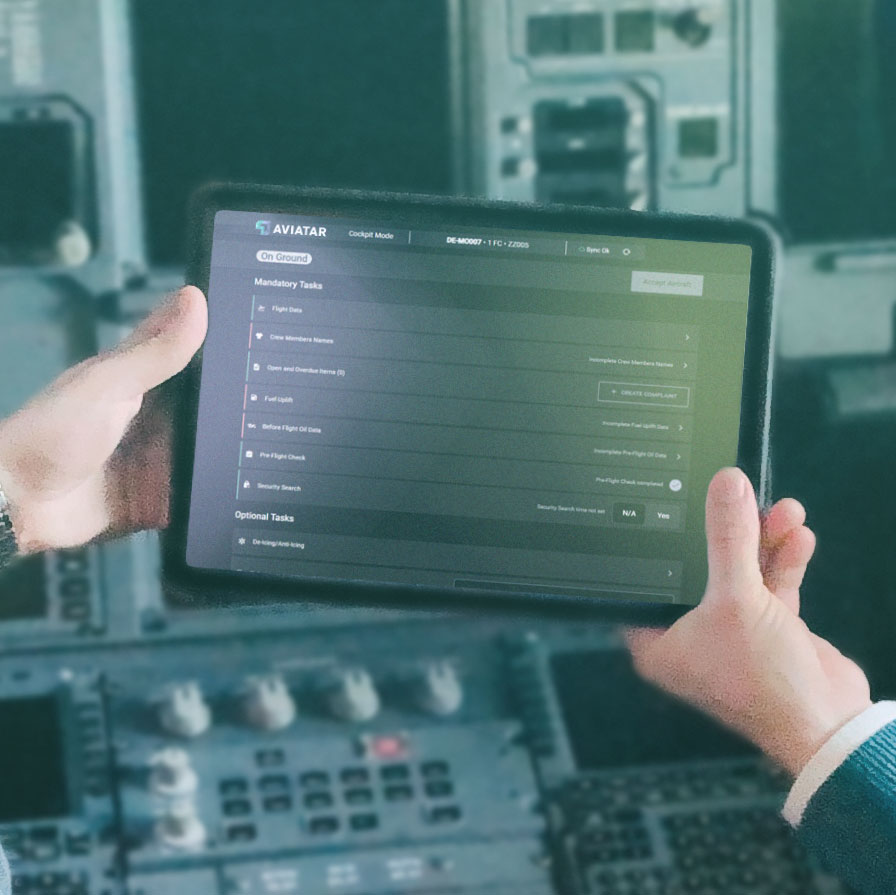
Air Transat, a leading Canadian leisure airline, has reached a major milestone in its digital Technical Operations (Tech Ops) transformation journey by introducing AVIATAR’s electronic Technical Logbook (eTLB), including the newly developed Digital Cabin Logbook, across its fleet of 43 Airbus A321 and A330 aircraft. After receiving Transport Canada’s authority approval for the operation of the eTLB, Air Transat is the first customer worldwide to operate this enhanced digital solution in both cockpit and cabin.
AVIATAR’s eTLB allows Air Transat to eliminate paper-based processes and enhance data transparency across its fleet and crews. It supports both short- and long-haul operations while meeting stringent regulatory requirements. As a fully integrated solution, it synchronizes with AMOS, the world-leading software for maintenance and engineering, and flydocs, global leaders in digital records and asset management. This ensures real-time data flow and conformity in Air Transat’s operations by automating technical dispatch and eliminating transcription errors, while ensuring regulatory compliance through digital signatures and centralized archiving.
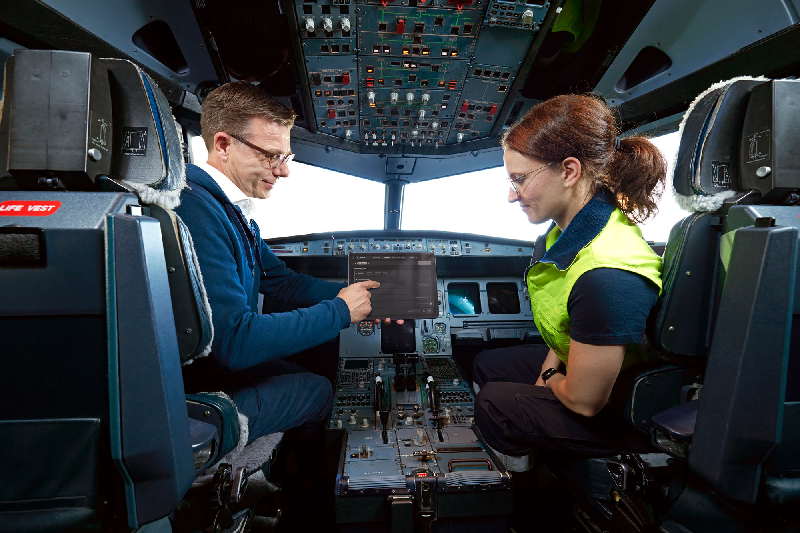
The new Digital Cabin Logbook expands Air Transat’s digital ecosystem to include cabin operations, allowing crews to capture relevant events in flight. Through structured inputs and standardized templates, cabin information can be shared across cockpit and maintenance teams and is synchronized with AMOS. By facilitating a parallel digital workflow, the solution aims to improve data quality, increase operational transparency, and reduce paper-based processes, contributing to greater efficiency and sustainability over time.
Fast-track implementation: From project kickoff to full fleet go live in less than a year
The project launched in February 2025 and received Authority Maintenance Approval – an important regulatory milestone –along with the release of the final logbook version, in January 2026. Starting with three aircraft in January, Air Transat successfully went live across the fleet at the end of February 2026, supported by a dedicated hypercare phase to ensure a smooth entry into service.
Building on this success, Lufthansa Technik and Air Transat are now exploring further AVIATAR integrations, including Predictive Health Analytics and Condition Monitoring, supporting the airlines’s ambition to become fully paperless in its Technical Operations.
“By choosing AVIATAR’s Electronic Technical Logbook, Air Transat made a forward-looking decision. As the world’s first AVIATAR customer to introduce the Digital Cabin Logbook, this implementation marks a major milestone in extending end-to-end digital aircraft documentation into the cabin,” said Arne Schlossmacher, Head of Sales and Customer Development AVIATAR Americas at Lufthansa Technik. “The close cooperation between the airline’s Tech Ops team, cockpit, cabin and ground crews, and AVIATAR developers made the fast-track implementation period possible. It reflects the strength of our partnership and lays the foundation for further digital solutions across Air Transat’s fleet to support its impressive approach to become fully paperless in Tech Ops.”
“The joint implementation project with the AVIATAR team was highly successful, going live in just eleven months,” said Helene Lormeau, Director Systems Support and Continuous Improvement at Air Transat. “Our teams worked closely with AVIATAR experts through multiple on-site workshops, becoming an active partner in developing and refining the solution. The flexibility of AVIATAR’s eTLB allowed us to meet the needs of a wide range of stakeholders – including Tech Ops, Flight Ops, IT, Training, MCC, and Transport Canada. Strong collaboration, clear communication and disciplined project management were key to the project’s success and laid the foundation for a successful digital transformation.”
Air Transat benefits from Lufthansa Technik’s Digital Tech Ops Ecosystem since 2007
By integrating AVIATAR’s eTLB with Swiss AviationSoftware’s AMOS and flydocs Digital Records Management, Air Transat benefits from all three core pillars, as well as Lufthansa Technik’s Engineering Services of the Digital Tech Ops Ecosystem, as it transitions toward a fully digital environment.
Lufthansa Technik’s Digital Tech Ops Ecosystem is a flexible, multi-application suite consisting of AVIATAR, the independent platform for data and analytics; AMOS, the world-leading software for maintenance and engineering, which Air Transat has been using since 2007; and flydocs, a global leader in digital records and asset management; supplemented by Lufthansa Technik Engineering Services. Each solution operates independently, but is designed to work together seamlessly, offering modular, integrated services through a customer-centric, collaborative approach along the whole value chain of technical operations. The Ecosystem is designed to boost process efficiency, reduce technical operating costs, enhance operational stability, and maximize aircraft availability and asset value across the full lifecycle – including lease transitions.
About Air Transat:
Founded in Montreal in 1987, Air Transat is a leading travel brand voted 2025 World’s Best Leisure Airline by passengers at the Skytrax World Airline Awards. Its program offers access to international destinations, mainly in Europe, the Caribbean, the east coast of the United States, America and North Africa. Air Transat is recognized for its excellent customer service. Its fleet includes some of the most energy-efficient aircraft in their category. Based in Montreal with major hubs in YUL Montréal-Trudeau International Airport and Toronto Pearson Airport (YYZ), it has 5,000 employees with a common purpose to bring people closer together. Air Transat is a business unit of Transat A.T. Inc. (TSX: TRZ). www.airtransat.com
About Lufthansa Technik:
The Lufthansa Technik Group is one of the leading providers of technical aircraft services in the world. Certified internationally as maintenance, production and design organization, the company employs more than 23,000 people in dozens of locations around the globe. Lufthansa Technik offers the full range of services for commercial, VIP and special mission aircraft. The portfolio includes maintenance, repair, overhaul and modification of airframes, engines, components and landing gears, as well as the manufacture of innovative cabin products and digital fleet support.
flydocs announces Go-Live of its Digital Records Management solution for Aeromexico

flydocs, the aviation global leader in digital records, asset management, and digital engineering services, has announced a strategic collaboration through a five-year software partnership with Mexico’s global airline, Aeromexico. As a result of this partnership, flydocs is proud to have achieved a successful migration and go-live in less than three months and is now supporting Aeromexico with its market-leading Digital Records Management (DRM) software package across its fleet of almost 170 aircraft.
This significant collaboration also strengthens Aeromexico’s existing partnership with flydocs’ Digital Tech Ops Ecosystem partner, Swiss AviationSoftware, the developer of the leading maintenance and engineering (M&E) software AMOS, which has served as the airline’s core system since 2015. With AMOS firmly established as the backbone of Aeromexico’s technical operations, the new partnership with flydocs creates an even stronger digital foundation by enabling a seamless flow of documentation between AMOS and flydocs’ DRM platform.
This alliance augments Aeromexico’s fleet management capabilities with flydocs’ DRM software to help maintain vital records quality, streamline processes, and support proof of compliance throughout the asset lifecycle. With the Onboarding process nearing its completion, it has made a significant impact in growing a strong partnership between Aeromexico, flydocs and AMOS.
Commenting on the partnership, Arne Schlossmacher, Head of Sales & Customer Development, Digital TechOps ecosystem Americas, said, “Our partnership with Aeromexico represents a significant milestone in our digital transformation journey within the aviation sector. By leveraging our core records management solution, we look forward to enhancing operational efficiency, driving cost savings, and elevating customer satisfaction. Aeromexico’s reputation for operational excellence and exceptional customer experience makes this collaboration especially exciting. Being chosen as their trusted partner underscores our commitment to supporting airlines across the Americas, further strengthening the regional presence and growth.”
About flydocs
flydocs is an asset management solution provider with the aviation industry’s most comprehensive solution for creating value out of aircraft maintenance data. We offer the tools and expertise that allow all industry stakeholders to drive sustainable innovation to help build the future of the commercial aviation asset lifecycle.
Recognised as a global leader in digital records management, flydocs was founded in 2007 and is 100% owned by Lufthansa Technik. With over 300 employees in multiple locations spread across the globe, flydocs is trusted by over 75 airlines, lessors, and MROs to deliver measurable long-term operational and cost efficiencies.